House panel withdraws AI personhood amendment after legal questions arise
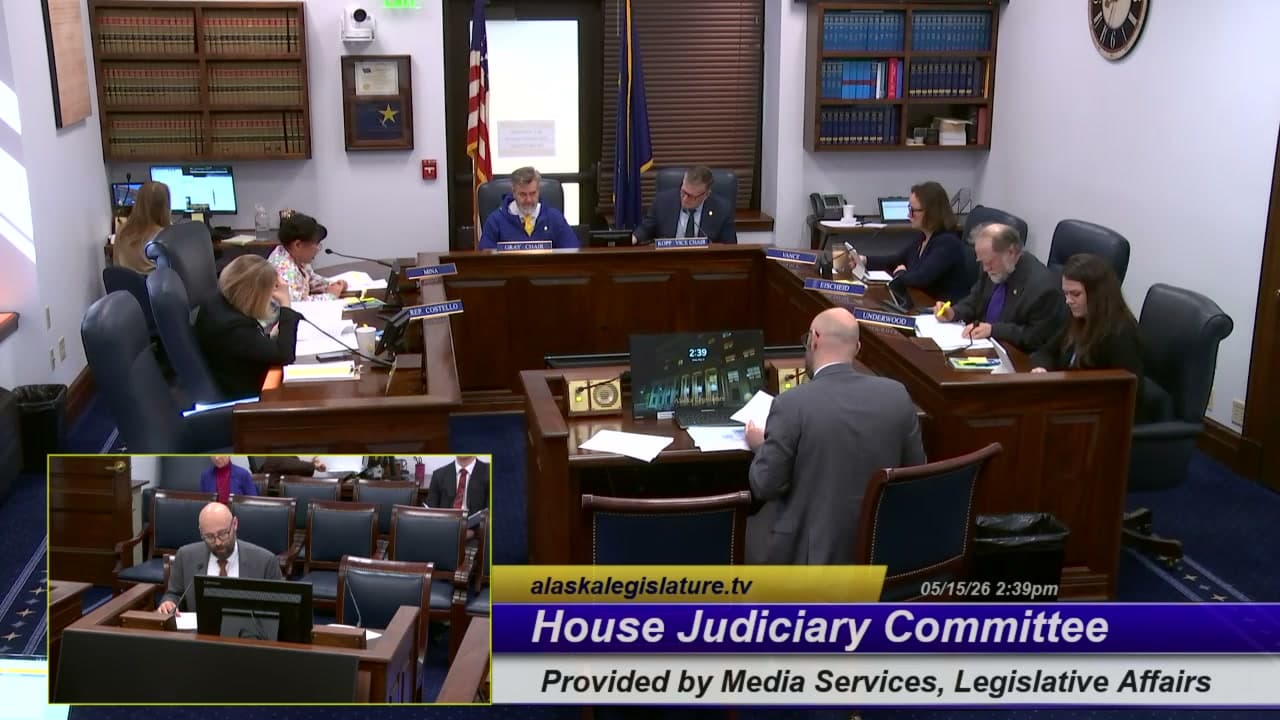
The Alaska House Judiciary Committee withdrew an amendment Friday that would have declared artificial intelligence systems cannot be recognized as legal persons. Lawmakers raised concerns the language could create unintended gaps in criminal law.
The committee was considering Senate Bill 252, which updates Alaska's commercial code to accommodate electronic records in secured transactions. Representative Sarah Vance proposed adding legislative intent language stating that nothing in the act could be construed as recognizing an AI system, automated agent, or machine learning system as a person.
"It is the intent of the legislature that nothing in this act may be construed as recognizing an artificial intelligence system, automated agent, or machine learning system as a person," Vance said. "We want to make sure that they do not inadvertently have the same rights as persons under the law."
Vance said the amendment was prompted by Section 21 of the bill, which includes an expanded definition of "person" that she feared could inadvertently apply to AI systems. She explained the amendment was framed as intent language rather than a statutory change to avoid disrupting the bill's status as uniform commercial code.
Committee Chair Andrew Gray questioned whether explicitly denying personhood to AI could exempt those systems from laws that apply to persons, including criminal statutes.
"My fear about Amendment 1 is if we say that they are definitively not people, are we telling the AI that these laws do not apply to them because these laws are for people?" Gray said.
Gray raised the example of an AI system that plagiarizes despite being instructed not to. He asked who would be held accountable: the person who requested the work, the person who created the AI, or the AI itself.
Representative Mia Costello said the questions raised by the amendment required more expertise than the committee had available.
"The level of expertise and like surveying of what's happening across the country with AI needs a little more in-depth discussion that we can't actually achieve in this bill," Costello said.
Representative Ted Eischeid said he would feel more comfortable with expert testimony before addressing AI classification. He noted that classifying AI as a corporation could raise issues similar to those in the Citizens United Supreme Court case.
"I would feel much more comfortable with these ideas if we had some experts we could talk to," Eischeid said. "I don't want us to get over our skis."
Staff to Sen. Matt Clayman, the bill's sponsor, told the committee the intent language likely would not change the substance of the bill, though they wanted to consult with experts before providing a final opinion. Clayman, who joined the meeting by teleconference, said he had not yet seen a copy of the amendment but did not object to the intent language based on the description provided.
Vance withdrew the amendment after the discussion. She acknowledged the complexity of the issue.
"I love this conversation, and now I am going to be thinking about paranoia has set in on election, on campaign finance, that someone could come up with the idea that AI could contribute to campaigns now," Vance said. After further discussion, she added: "Because there's so much, so many questions without answers, I will withdraw Amendment Number 1."
The committee then voted to advance Senate Bill 252 without the AI personhood language. The bill now moves to the House floor.
This article is based on a public meeting — HJUD-260515-1300 ().
AI-assisted. How we use AI Transcript byLucas Brown
Stay informed. Support what matters.
Free, permanent access to local news you can verify. Subscribe to support Alaska News and go ad-free.
Related Coverage
House Committee Extends Deadline for AI Personhood Amendment
Alaska News · 6mo ago
Alaska Senate panel advances autonomous vehicle restrictions despite industry opposition
Alaska News · 4mo ago
House Advances Corporate Tax Bill, Rejects AI and Nuclear Amendments
Alaska News · 6mo ago
Senate panel advances bill requiring humans in autonomous commercial vehicles
Alaska News · 4mo ago
Autonomous vehicle bill advances despite state warnings on outdated standards
Alaska News · 4mo ago
Comments
Sign in to leave a comment.
No comments yet. Be the first to share your thoughts.