
Photo by Mikhail Nilov on Pexels · Photo source
Alaska Auto-IRA Bill Lets Workers Save PFD for Retirement
The Alaska Legislature passed Senate Bill 21, establishing the Alaska Work and Save Program. The program allows private-sector workers to automatically deposit their Permanent Fund Dividend checks into retirement accounts. The bill now awaits the governor's signature.
Senator Bill Wielechowski, D-Anchorage, Representative Mia Costello, R-Anchorage, and Representative Dan Saddler, R-Chugiak, sponsored the legislation. The program integrates with the existing Pick.Click.Give program. Workers can direct their annual dividend into retirement savings.
The program targets roughly half of Alaska's private-sector workers who lack employer-sponsored retirement plans. Employees are enrolled automatically, with contributions deducted from each paycheck. Workers retain the right to opt out at any time.
Employers forward payroll deductions but are not required to contribute to employee accounts. Representative Costello said small businesses testified that the program allows employees to save automatically at no cost to employers.
Alaskans aged sixty and over are expected to double between 2010 and 2030. The average monthly Social Security benefit is $2,071. The average monthly cost of living in Alaska is $4,528.
Senator Wielechowski said seniors are relying more on SNAP, falling below the poverty line, and struggling to get by on Social Security, which does not come close to covering Alaska's cost of living. The bill gives workers an automatic way to save and costs employers nothing, he said.
Seventeen states have established comparable state-sponsored auto-IRA programs. The bill now heads to the governor's desk.
What did you make of this story? (no account needed)
Made by our human newsroom with AI. How humans and AI work here · Grow with our newsroom ·
Keep Alaska News free for everyone.
No paywall, ever. Members pay so everyone can read the meetings and records Alaska News covers.
Get Alaska News in your inbox
Create your free account and get the day’s top stories around 6 each morning, in a few minutes’ read.
Top stories, around 6 each morning.
Stories on what you follow, on Sundays.
Based on a press release.
Earlier in this story
House Finance Committee advances auto-IRA bill for Alaska workers
The House Finance Committee advanced legislation Sunday creating an automatic IRA program for Alaska employees whose employers do not offer retirement plans.
Senate Bill 21 establishes the Alaska Work and Save program. The program would set up individual retirement accounts for workers at businesses that do not provide employer-sponsored retirement benefits. Employees can opt out or adjust the contribution rate upon hiring. The program may be administered by Alaska or through a partner state.
At least 17 other states have implemented similar programs.
Senator Bill Wielechowski introduced the measure. He said the program addresses a barrier that prevents small businesses from offering retirement benefits to employees. Research shows that setting up a retirement program can cost a small business anywhere from $4,800 to $17,000 per year.
"This program will help Alaskan businesses offer a competitive benefit at no cost," Wielechowski said. "My office has received over 50 letters of support from small businesses all across Alaska."
Wielechowski said 71 percent of small businesses express concern about the cost to operate a retirement plan. A survey by the American Association of Retired People for Alaska revealed that 86 percent of small businesses say that more should be done to encourage Alaska residents to save for retirement.
The bill creates a statewide program that would set up individual retirement accounts for workers who do not already have employer-sponsored retirement plans. The savings would be fully portable when an employee changes jobs or retires. Employees could also direct all or a portion of their permanent fund dividend toward the retirement account.
Wielechowski said the bill was revised to exempt businesses with five or fewer employees that have been in operation for less than three years. The bill removes all penalties and fines for employers who do not participate.
"This is not an attempt to be oppressive for small businesses," Wielechowski said. "We are removing the fines and the penalties."
The bill also includes a provision to ensure that participants can benefit from future federal incentives. Those include potential $1,000 retirement incentives established under the SECURE 2.0 Act that President Trump spoke about during his State of the Union address.
Wielechowski said the percentage of Alaska seniors living below the poverty level nearly doubled between 2010 and 2021. One in 10 Alaskan seniors now lives below the poverty level. The number of seniors receiving SNAP benefits has doubled along with that.
"When Alaskans do not have savings, there is more of a reliance on state programs like SNAP and Medicaid, which cost our state hundreds of millions of dollars per year," Wielechowski said.
Over 100,000 Alaskans work for small businesses. Yet 64 percent of small businesses do not offer any retirement at all.
Representative Jeremy Bynum moved the bill out of committee with individual recommendations and attached fiscal notes. The committee advanced the bill without objection. The motion also authorized legislative legal to make technical and conforming changes as necessary.
House panel advances retirement savings program for private workers
The Alaska House Finance Committee heard testimony Friday on legislation that would create a state-facilitated retirement savings program for private sector workers whose employers do not offer retirement plans.
Senate Bill 21 would establish Alaska Work and Save, an automatic individual retirement account program that would enroll employees at a default contribution rate of 5 percent of their paycheck. The program would exempt businesses with five or fewer employees and those operating less than three years.
State Senator Bill Wielechowski, the bill's sponsor, said more than half of American households have no retirement savings at all, and 64 percent of small businesses in Alaska do not offer any retirement plan. He said the barrier is cost. Setting up a retirement program can cost a small business $4,800 to $17,000 per year.
"This is the state providing this option for small businesses at no cost to the businesses at all," Wielechowski said.
The program would allow Alaska to join a multi-state partnership to keep costs low. Seventeen other states have enacted similar legislation.
Marge Stoneking, advocacy director for AARP Alaska, told the committee that insufficient retirement savings leads to greater reliance on state-funded public assistance programs later in life. She said if the access gap is not addressed, Alaska could face $708 million in increased reliance on programs like SNAP and Medicaid through 2040.
She said if Alaska households saved an average additional $920 per year, just $75 per month, they could erase that projected public assistance burden and improve their own retirement security.
Stoneking urged the committee to restore compliance language for employers so that every eligible Alaskan worker has a chance at a secure retirement. She said states with compliance provisions in statute have seen faster program growth. Colorado's program took five months to hit 10,000 funded accounts, while Maryland's took 27 months. The key difference is that Colorado has compliance included in statute. Wielechowski said the bill's sponsors removed all penalties and fines to avoid being oppressive to small businesses, a tradeoff that has left the compliance mechanism weaker than advocates prefer.
Small business owners testified in support of the program. John Weddleton, who owns a retail business in Anchorage with 34 employees, said very few of his employees have ever thought about saving for retirement.
"This Work and Save, not only does it provide a really simple mechanism for saving, but it's also a reminder that they should be," Weddleton said. "You know, with every paycheck, it's like, hey, this is the thing, you need to pay attention to it."
Jenny Sheppard, who owns a general store in Glennallen with her husband and a business partner, said their business has not qualified for retirement plans or it has been too consuming to look at one. She said being able to offer something like this for the folks that work for them would help younger employees save so they do not have to live through what their parents or grandparents do.
The program would be portable, following workers when they change jobs or work seasonally. Employees would be automatically enrolled but could opt out or adjust their contribution rate. The bill also includes a provision allowing Alaskans to direct deposit their Permanent Fund Dividend into an investment account of their choice.
The committee reviewed two fiscal notes. The Permanent Fund Dividend Division submitted a zero fiscal note. The Department of Revenue Treasury Division fiscal note requests $660,000 for fiscal year 2027 and approximately $355,000 per year from 2028 to 2032. The costs include two staff positions, travel expenses, office expenses, and an estimated $300,000 startup fee to join a multi-state partnership similar to Colorado's system.
Co-Chair Neal Foster set an amendment deadline for Saturday at 5 p.m.
House panel advances retirement savings program with PFD deposit option
Alaska House committee approved a retirement savings program for 105,000 workers without employer plans and expanded options to deposit Permanent Fund dividends into existing investment accounts.
Read this story
The Alaska House Labor and Commerce Committee advanced a state-sponsored retirement savings program Monday that would help an estimated 105,000 workers without employer plans save for retirement.
The committee approved Senate Bill 21, which creates Alaska Work and Save, an automatic-enrollment individual retirement account program for employees at businesses with five or more workers that have operated for at least three years. The bill passed out of committee as amended with individual recommendations.
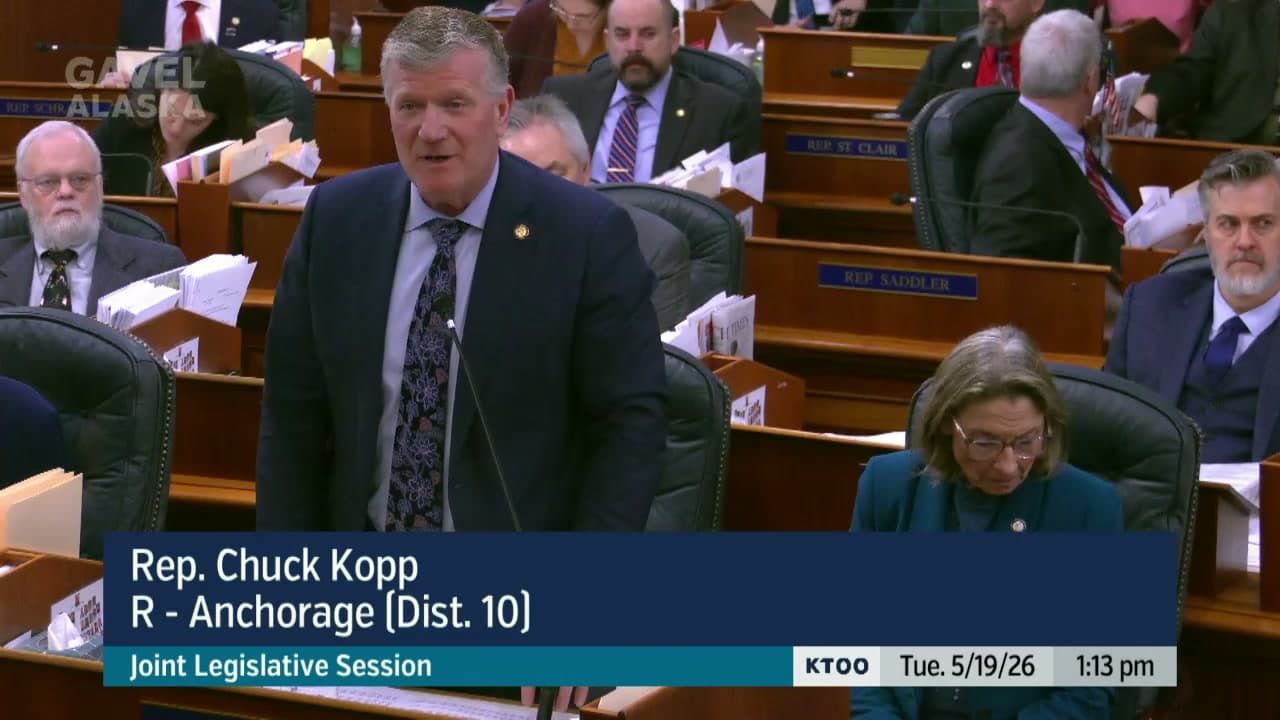
Before approving the measure, members adopted an amendment allowing Alaskans to deposit their Permanent Fund dividends into existing investment accounts, not just the new Work and Save accounts. While Alaskans can already direct PFDs to certain investment accounts such as Alaska 529 plans through the annual dividend application process, the amendment would expand those options to include other existing retirement investment accounts. The amendment, introduced by Representative Sadler, had previously been heard as standalone legislation during the 33rd Legislature as House Bill 245.
"The underlying bill, SB 21, would not only establish the Alaska Work and Save program, it also lets participants in the program deposit their Permanent Fund dividends into their Work and Save accounts," Sadler said. "My amendment here simply gives Alaskans that same opportunity to deposit their Permanent Fund dividends into existing investment accounts instead of relying on the ones created under Work and Save."
Maxine LaBerge, staff to Senator Wielechowski, said the bill sponsor supported the amendment because it aligned with the underlying policy goal of helping people save for retirement.
The committee rejected three other amendments that would have made the program voluntary or expanded business exemptions. One amendment would have allowed employers to opt in or opt out of the program rather than requiring participation. Another would have let employees choose whether to participate instead of the current automatic enrollment with an opt-out provision.
LaBerge said data shows workers are 20 times more likely to save when automatically enrolled, and that 65 to 80 percent of participants in existing state programs stay enrolled. She cited low participation rates in states with voluntary programs.
"New Mexico, Hawaii, and Massachusetts all have had kind of optional programs with pretty low rates of success where the seeing is as low as only 2.5 percent of eligible savers participating in the program," LaBerge said.
A third amendment would have raised the employee threshold for mandatory participation from five to 10 workers. Senator Wielechowski said that change would disqualify 22,769 employees, roughly 13.4 percent of employers. He said businesses with five or more employees operating for three years likely already have payroll systems in place.
"This is not a hard thing to do," Wielechowski said.
Two members of the public testified in support of the bill. Lou Theiss of Girdwood said his 35-year-old son has worked in small retail businesses since age 16 and never had access to a tax-deferred retirement account. He noted that starting in 2027, the federal SECURE Act 2.0 will provide a 50 percent match of up to $1,000 for lower-income savers in state-sponsored programs and tax credits to employers for implementation costs.
John Weddleton, an Anchorage business owner, said few of his long-term employees have saved for retirement despite decades of service. He called the program a gift for businesses like his that makes saving simple and creates a reminder with each paycheck that retirement savings matter.
The program joins a multistate partnership that makes it financially feasible for Alaska and savers, according to LaBerge. The bill now moves to its next committee of referral.
Alaska House panel hears retirement savings bill for small business workers
Alaska House panel heard testimony on HB 338, which would create automatic retirement savings accounts for workers at small businesses that lack retirement plans.
Read this story
The Alaska House Labor and Commerce Committee heard testimony Monday on legislation that would establish an automatic retirement savings program for workers at small businesses across the state.
HB 338, sponsored by Representative Mia Costello and introduced on February 23, 2026, would create the Alaska Work and Save Program. The program would set up automatic payroll deduction IRAs for employees at businesses with five or more workers that do not already offer qualified retirement plans. The bill targets businesses that cannot afford to provide retirement benefits. Ninety-nine percent of Alaska businesses are classified as small businesses.
"Work and Save is really important for Alaska because it allows small businesses to offer their employees a retirement account," Costello said. "We know that Alaska has an aging population, the fastest-growing aging population in the country."
The Department of Revenue or a designee would administer the program. Employees would be automatically enrolled but could opt out or adjust contribution rates. A portion of Permanent Fund dividends could also be directed into the accounts.
Nearly half of private-sector employees in Alaska lack a retirement plan. Senate Bill 21, a companion measure introduced in January 2025 by State Senator Bill Wielechowski, would create a similar auto-IRA program with automatic enrollment and opt-out provisions. Seventeen other states have enacted comparable programs, with workers saving nearly $3 billion to date.
Marge Stoneking, advocacy director for AARP Alaska, told the committee that half of Alaska households have no retirement savings. She cited an AARP survey showing 70 percent of Alaska small business owners support the program.
"Without access to retirement savings at work, nearly all workers fail to save, putting them at risk of poverty and reliance on public assistance as they age," Stoneking said. "If this access gap is not addressed, it is estimated that Alaska will face $708 million in increased reliance on state-funded public assistance programs like SNAP and Medicaid through 2040."
Workers are 15 times more likely to save when they can do so through payroll deduction and 20 times more likely when automatically enrolled, she said.
Jessica Ekman, a government affairs director with AARP's national office, emphasized the importance of compliance provisions in the legislation. She said Colorado's program reached 10,000 funded accounts in five months, while Maryland's took 27 months. She attributed the difference partly to Colorado including enforcement language in its statute.
"States do not always choose to enforce, but the ability to do so is hugely important to ensuring access to retirement savings for all eligible workers," Ekman said.
Both Colorado and Connecticut partnerships include enforcement provisions. States without compliance language may not be eligible to join those multi-state partnerships, which reduce costs and administrative burdens, Ekman said.
Hunter Raley, executive director of the Colorado Department of Treasury, testified that Colorado's program has enrolled nearly 18,000 employers and opened nearly 110,000 funded accounts with more than $200 million in assets in just over three years.
"The cost of doing nothing was estimated would be $18 billion in redirected taxpayer funds over a 15-year period," Raley said of Colorado's pre-program analysis. "That number is from late 2019. That is almost certainly higher as of right now."
Raley said employer onboarding takes about 15 minutes and ongoing administration takes about five minutes monthly. Many employers use payroll integration that requires no further action after initial setup.
Colorado saw a 45 percent increase in private retirement plan adoption after implementing its program, according to the payroll provider Gusto. The state had the highest private plan adoption rate in the country in 2022, Raley said.
Zach Young, staff to Representative Costello, said the program would operate at no cost to employers beyond standard agreed-upon wages. Employers would not be required to match contributions, though they could choose to do so.
The bill applies only to businesses with five or more employees that have been operating for at least three years. Businesses that already offer qualified retirement plans would be exempt.
HB 338 includes civil enforcement provisions under the Department of Labor, with penalties of up to $100 per eligible employee and a maximum of $5,000 annually. The Senate companion version removed those sections due to concerns about penalizing small businesses.
The committee took no action on the bill Monday. HB 338 remains in the House Labor and Commerce Committee. A Senate hearing on the companion measure is scheduled for Wednesday.
Senate Passes Alaska Work and Save Retirement Program 15-4
The Alaska Senate passed a bill creating an automatic retirement savings program for employees at small businesses. It now heads to the House.
Read this story
The Alaska Senate voted Tuesday to establish the Alaska Work and Save Program, a first-in-Alaska automatic retirement savings plan for workers whose employers do not offer retirement benefits.
Senate Bill 21 passed 15-4 after more than a year of committee work that reshaped the bill to address business concerns. The program creates individual retirement accounts for employees at businesses with five or more workers that have been operating for at least three years and do not already offer retirement plans. Employees may opt out at any time.
Senator Bill Wielechowski presented the bill to the Senate Finance Committee in February, according to the American Society of Pension Professionals and Actuaries. The bill had previously cleared the Labor and Commerce Committee in April 2025.
"Over half of American households have no retirement savings at all, and over 20 percent of Alaska's population is retirement age or older," Wielechowski said. "The IRS has reported that the average monthly Social Security payment for 2026 is around $2,000, yet the average cost of living in Alaska exceeds $5,000 per month."
Wielechowski said the percentage of Alaska seniors living below the poverty level nearly doubled between 2010 and 2021. One in 10 Alaskan seniors now lives below the poverty level. "The number of seniors receiving SNAP benefits has doubled right along with that," he said. "Over 100,000 Alaskans work for small businesses, yet 64 percent of small businesses don't offer any retirement at all."
The bill also allows workers to set aside a portion of their Permanent Fund Dividend in a tax-advantaged account, Wielechowski said. He cited low participation rates in opt-in programs to explain the rationale for automatic enrollment. "In New Mexico's Work and Save program, they had an opt-in. It never reached financial feasibility," Wielechowski said. "Massachusetts, which has an optional program, has only a 5 percent participation rate because it's opt-in. Washington has an optional marketplace program that's estimated to only have 2.5 percent participation."
The bill removes all penalties on businesses and exempts companies with fewer than five employees or less than three years in operation. "We've removed all the penalties and fines," Wielechowski said.
Senator Robert Myers said he remained conflicted about the bill despite supporting portable benefits. "I've been conflicted about this bill the last few days as I saw it coming to the floor," Myers said. "It is a form of portable benefits, which I think is good, which is spreading throughout the country as something absolutely necessary. But I've also been a little concerned. We've got a mandate for business in here."
Myers said the Alaska Chamber opposes the employer mandate. He voted against the bill.
Wielechowski said a survey by AARP Alaska found that 86 percent of small businesses say more should be done to encourage Alaska residents to save for retirement. Seventeen other states have implemented similar programs, he said.
The bill now moves to the House, where it was referred to the Labor and Commerce and Finance committees.







Comments
Sign in to leave a comment.
No comments yet. Be the first to share your thoughts.