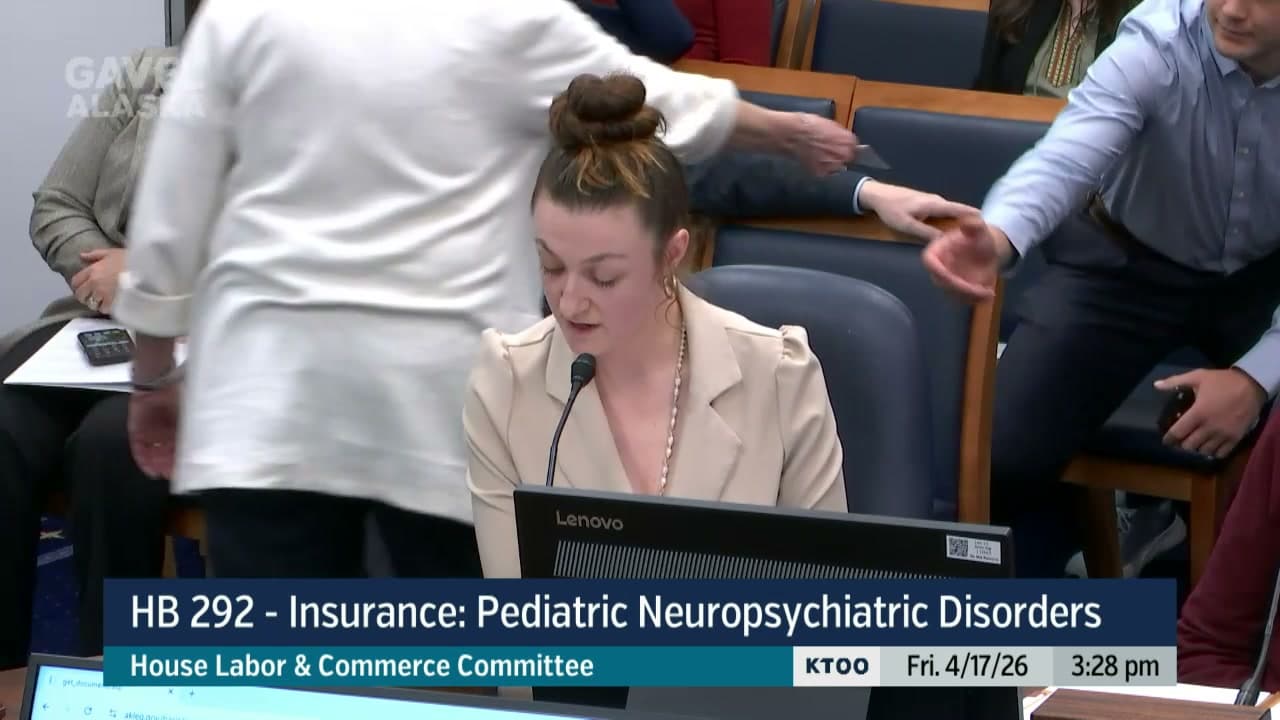
House committee advances insurance coverage for PANDAS/PANS treatment
The Alaska House Labor and Commerce Committee heard emotional testimony Friday on legislation that would require insurance companies to cover treatments for children suffering from devastating neuropsychiatric disorders triggered by infections.
House Bill 292 addresses coverage for PANDAS and PANS, pediatric autoimmune neuropsychiatric disorders that cause sudden, severe behavioral changes in children. The bill would mandate insurance coverage for treatments including intravenous immunoglobulin therapy, which currently costs families tens of thousands of dollars out-of-pocket when insurers deny claims.
The legislation moved out of the Labor and Commerce Committee on April 17, 2026, with all six members voting "Do Pass." It now heads to the House Finance Committee. The bill previously cleared the House Health and Social Services Committee on March 17, with three members voting "Do Pass" and two offering "No Recommendation."
Representative Julie Coulombe introduced the bill after hearing from constituent Rebecca Pullins about her son Finn. Coulombe said the legislation puts kids first and ensures parents can get the treatments their children need.
"She talked me through her family's journey with PANDAS and PANS, which are neuropsychiatric disorders," Coulombe said. "And their fight with insurance companies who deny medically necessary care."
Pullins testified that her seven-year-old son changed overnight after a strep infection. He developed obsessive-compulsive disorder, uncontrollable body movements, and fits of rage. Getting dressed took 45 minutes. He could not eat or play with his sister.
"We thought we had lost our son," Pullins said. "Our daughter had lost her playmate and best friend. We were terrified we would never get him back."
The disorders occur when a strep infection or other trigger causes a child's immune system to attack the brain instead of the infection. Symptoms can include sudden onset of OCD, anxiety, rage, inability to function, and physical tics. Without quick diagnosis and treatment, children may need expensive interventions.
One mother testified that her 14-year-old son was taken to McLaughlin Youth Center in Anchorage in 2025 after a terrifying escalation of behaviors. Juvenile detention was the only option available after repeated denials from psychiatric and medical facilities.
"My son was not a criminal," she said. "He was a child experiencing severe brain inflammation, but no one knew that yet."
It took more than a decade to find treatment. When her son was released from detention, she started him on maximum-dose ibuprofen. Within 72 hours, the violent aggression was gone. Comprehensive labs showed almost everything was abnormal: inflammatory markers, autoimmune indicators, infectious titers, hormone disruption.
She said the financial cost to her family and to the state of Alaska in the last decade likely approaches half a million dollars for care that was not addressing the real problem. She holds a master's degree but can only work a flexible low-wage job because of her children's care needs. The family relies on Medicaid for healthcare, subsidized housing, and food assistance.
Months after her son's diagnosis, her daughter began exhibiting symptoms of PANS. Because she now understood the condition, she recognized the behavior immediately and treated her daughter with anti-inflammatories within days of onset. Her symptoms resolved in less than 48 hours.
"Early recognition and treatment changed her life," she said. "She will likely never see a psychiatric emergency room or juvenile detention facility."
Dr. Rosario Tang, who works with the Stanford PANS Clinic and is also a mother of a PANS patient, described the cat-and-mouse game that starts when a physician decides expensive medicine is needed. Insurance companies typically auto-deny claims for IVIG therapy, she said.
Every insurance company except one has a policy stating the medicine is not necessary or experimental, Tang said. The companies realize very few people will appeal, less than one percent. But if families go through multiple stages of appeals and reach independent medical review at the regulatory level, most cases side with the family.
"It is normal for kids, once the decision is made that they are severe enough to need IVIG, to need to wait 6 to 12 months to get the medicine," Tang said. "And, you know, this is despite the fact that greater than 4 weeks is considered to be very delayed treatment."
In the meantime, children are not in school or need special education, parents cannot work, and families may enter financial ruin trying to pay for treatment themselves. There are potentially lasting neurologic consequences and even death. A brain bank at Georgetown in Washington, D.C., has been established with children who have died from the disease, and every year they get a few more, Tang said.
Alaska joins a national trend. Twenty states have established PANS and PANDAS insurance coverage through legislation or policy: Arizona, Arkansas, California, Colorado, Delaware, Georgia, Idaho, Illinois, Indiana, Kansas, Louisiana, Maryland, Massachusetts, Minnesota, New Hampshire, Oregon, Rhode Island, Tennessee, Virginia, and Washington. Actuarial analyses from states that have enacted similar mandates show negligible impact on insurance premiums. Virginia estimated the cost at $0.0046 per member per month, less than half a cent. The Rhode Island Office of the Health Insurance Commissioner confirmed that mandated PANS and PANDAS coverage does not meaningfully increase premiums.
Heather Carpenter, Director of the Division of Insurance, told the committee that patients can appeal insurance denials through an external healthcare review process. The division contracts with reviewers not associated with insurance companies who examine all files and determine whether a child should have received medication.
"I will acknowledge that is a frustrating process for any insurance, whether it is regulated by the division or if it is a self-insured plan," Carpenter said. "Having to appeal to that final decision-making can take a lot of effort, and when you have other things going on with your kids, that is exhausting."
Carpenter said the division has not heard anything specific about lack of IVIG approval beyond PANS and PANDAS. After testimony in the House Health and Social Services Committee, Aetna sent Carpenter their updated bulletin of coverage. Aetna is the first insurer to change its policy and now covers IVIG for PANS and PANDAS.
The bill includes provisions requiring insurance companies to provide coverage in a timely manner, ensuring no unnecessary delays. It also prevents insurers from using higher costs to financially punish families affected by PANS or PANDAS. The legislation defines uniform terminology for the disorders to ensure treating providers, insurers, and families all have shared language for understanding insurance coverage.
Carpenter noted there are some technical items that were going to be considered in the House Health and Social Services Committee, but the committee ran out of time. Representative Coulombe has those technical fixes that the division pointed out.
Co-Chair Carolyn Hall set an amendment deadline for Thursday, April 23, at 5 p.m. The committee will hold the bill for future consideration.
This article is based on a public meeting — Alaska Legislature: House Labor & Commerce, 4/17/26, 3:15pm ().
AI-assisted. How we use AI Transcript byLucas Brown
Stay informed. Support what matters.
Free, permanent access to local news you can verify. Subscribe to support Alaska News and go ad-free.
Related Coverage
House panel fast-tracks insurance coverage for PANDAS treatment
Alaska News · 5mo ago
House Finance Advances Mental Health Education Guidelines for Schools
Alaska News · 5mo ago
House passes bill requiring transparency at psychiatric hospitals for minors
Alaska News · 5mo ago
House Labor Committee Advances Travel Insurance Bill, Hears Disaster Pet Plan
Alaska News · 5mo ago
House panel advances travel insurance consumer protection bill
Alaska News · 5mo ago
Comments
Sign in to leave a comment.
No comments yet. Be the first to share your thoughts.