Gas line tax break delivers 20% savings, far less than competing states
A consultant told the Senate Resources Committee Saturday that Alaska's current gas line tax bill gives developers a 20% savings when using discounted cash flow analysis. That is far less than the 65% savings they would see if Alaska delayed tax collection for 10 years.
Nick Fulford works as a gas and LNG energy transition specialist at Gaffney Cline. He explained that the first 10 years of a project are pivotal for developers because of the time value of money. After 10 years, money's value drops to about one-third of what it was on day one.
Fulford said Alaska's approach is less competitive than states that offer full 10-year property tax forgiveness. Texas and Louisiana offer complete property tax forgiveness for the first 10 years. When using discounted cash flow analysis, Fulford said the current bill version L provides developers a 20% discount on property taxes that would otherwise apply. Without discounting, the savings would be just 8.6%.
"The saving in the eyes of the developer using this TCF approach, and obviously they may well use something different, but using this TCF approach, you move from a saving of 8.6% in the undiscounted version to a saving of 20% in the discounted version," Fulford said. "And the reason for that is that the differences between conventional property tax and the AVT in that first 10 years, as you can see from the graph on the left, are quite material."
Fulford said investors and lenders focus on discounted cash flow rather than nominal figures. "For an investor, for a lender, for a commercial entity, really it's the graph on the right that will be more important to them than the graph on the left," he said.
If Alaska delayed tax collection for 10 years and spread the same total revenue over years 10 through 30, the savings would jump to 65%. Fulford presented an additional scenario showing that deferring full property tax for 10 years and then collecting it later would still yield a 63% discounted saving.
"What this does show, and what I like about this slide is that it illustrates so clearly why Texas, Louisiana, elsewhere, why these 10-year tax holidays of one sort or another are so key," Fulford said. "Because from a discounted cash flow perspective, it moves such a lot of the value into the back end of the project and moves such a lot of value back into the front end, which is really what drives investors and lenders."
Senator Forrest Dunbar asked whether the 20% savings in the current bill would be enough to make the project competitive. Fulford said the project remains marginally profitable even with current tax structures, but uncertainties remain.
"These AVT numbers continue to represent quite a significant challenge for the project," Fulford said. "Comparing the delivered cost of the gas to the U.S. Gulf Coast or competing projects, we know that it's in a very narrow range of profitability."
Fulford said Alaska's situation differs from Texas and Louisiana because the state would still collect an assessed value tax during the first 10 years. "In Texas and Louisiana, and certainly Louisiana, there's an entire forgiveness of property tax in the first 10 years," Fulford said. "And so you could argue then that returning to the status quo for the latter 10 years is a perfectly reasonable outcome."
He added that Alaska's AVT complicates direct comparisons. "The big difference here, of course, in Alaska is that there is an AVT which applies in that first 10 years. So therefore, the reasonableness of putting it back to property tax after 10 would have to be looked at in that context in terms of its, we're not comparing apples to apples."
Fulford noted that the state could borrow money to cover the first 10 years of lost revenue and pay it back with higher taxes in later years. The state's cost of borrowing is typically around 3%, compared to the 10% discount rate developers use.
The committee also adopted an amendment that exempts a Fairbanks natural gas spur line from state petroleum property taxes and gives municipalities the option to exempt all or part of the tax. The exemptions would expire after 10 years or if construction does not begin on schedule.
The committee will meet again at 3:30 p.m. this afternoon to review comments from the Alaska Municipal League about the community assistance program in the bill. The Department of Revenue is preparing additional modeling that will not be ready until Monday.
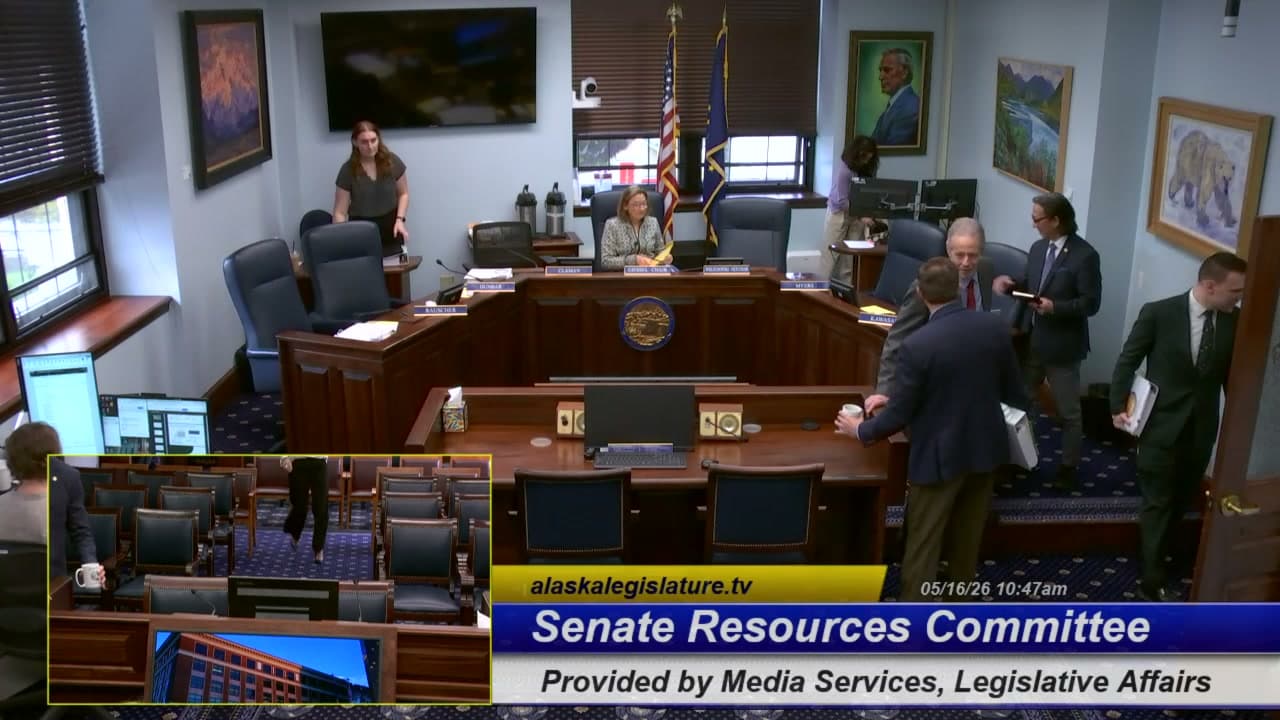
This article is based on a public meeting — Senate Resources, 5/16/26, 10am ().
AI-assisted. How we use AI Transcript byLucas Brown
Stay informed. Support what matters.
Free, permanent access to local news you can verify. Subscribe to support Alaska News and go ad-free.
Related Coverage
Energy consultant: Alaska LNG tax bill could cut delivered cost by 20 cents
Alaska News · 5mo ago
Alaska gas line faces economic challenge even with tax breaks
Alaska News · 4mo ago
Alaska LNG Consultant Flags Potential 50% Return for Developers vs. $1B State Revenue
Alaska News · 5mo ago
Alaska LNG faces tax competition from Canadian projects with federal support
Alaska News · 4mo ago
Energy consultant tells House Finance that property tax makes Alaska LNG unfinanceable
Alaska News · 4mo ago
Comments
Sign in to leave a comment.
No comments yet. Be the first to share your thoughts.