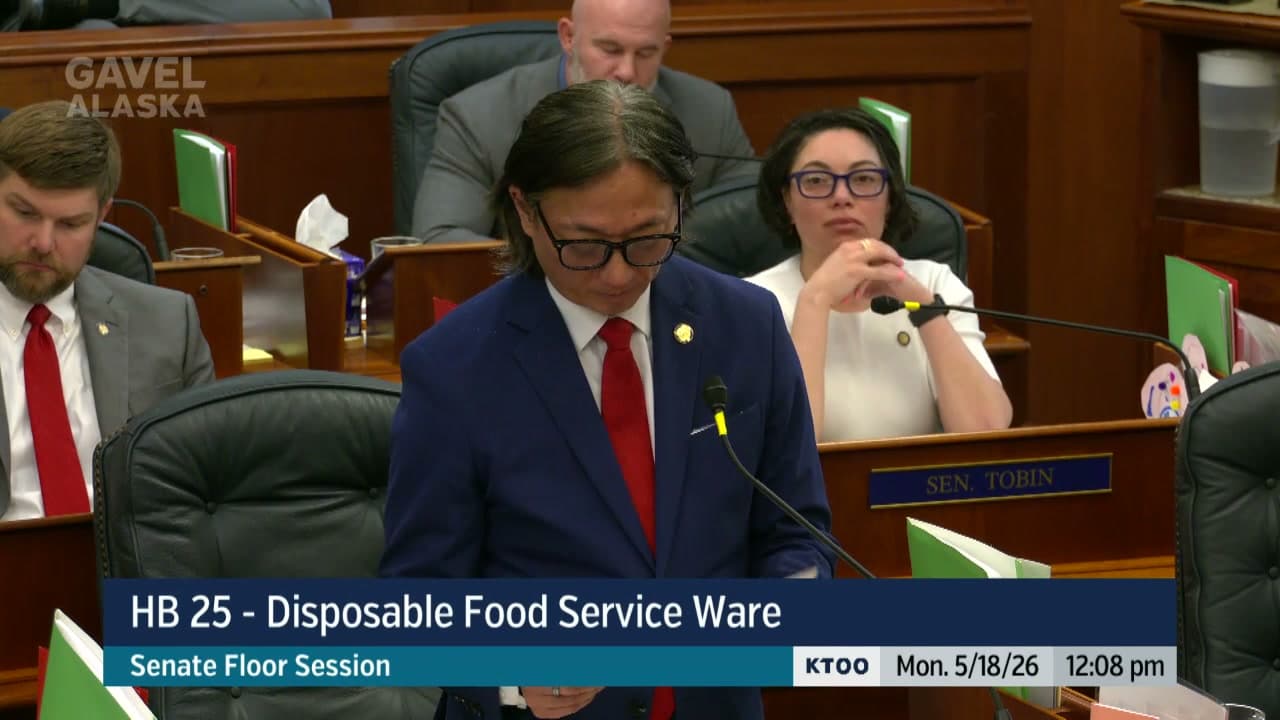
Alaska Senate Passes Statewide Styrofoam Ban for Restaurants
The Alaska Senate voted May 18 to ban polystyrene food containers at restaurants statewide. Supporters cited health and environmental concerns. The measure leaves most polystyrene use untouched.
The Senate passed House Bill 25 by a vote of 13 to 7. The measure prohibits restaurants from using polystyrene foam serviceware beginning January 1, 2027. Businesses may continue using existing stock after that date. The bill includes a local option allowing communities to reverse the ban if desired.
Senator Scott Kawasaki carried the bill. He said polystyrene leaches into food, disintegrates into waterways, and cannot be recycled. Diseases associated with polystyrene include leukemia and lymphoma, he said. The material affects reproduction and disrupts endocrine function, he said.
An oncologist from Juneau wrote in support of the measure, noting concerns with reproductive health, disruption of endocrine function, and the triggering of inflammation and cellular toxicity. The National Toxicology Program called styrene reasonably anticipated to be a human carcinogen.
Polystyrene containers decompose into tiny pieces that marine mammals eat. The bioaccumulation in those animals passes from mother to offspring, crosses their blood-brain barrier, and passes through breast milk. Communities across Alaska who rely on marine mammals for subsistence or traditional use hunt these animals. That same polystyrene impact crosses the blood-brain barrier of infants after passing from mother to infant through breast milk. Any polystyrene used today will be present in the environment 200 years from now.
Lawmakers said restaurant serviceware accounts for less than 10 percent of polystyrene introduced into Alaska. The remainder comes from packing materials. Up to 50 percent comes from items shipped to Alaska, specifically to remote communities. Banning all polystyrene would challenge those communities, though the industry is making improvements.
The bill's narrow scope drew criticism from opponents. They said it disadvantages restaurants while leaving packing materials, coolers, and fish boxes untouched. One senator said if polystyrene is environmentally unfriendly or toxic, the state should ban it for everybody. The measure disadvantages Alaskan businesses at the expense of corporations from outside, he said. The only people who will not be able to provide polystyrene are hardworking Alaskans who operate small businesses, he said.
Senator Julie Coulombe said most restaurants in Anchorage do not use polystyrene foam. If the state wants to address a public health issue, the number one public health issue in Alaska is alcohol, she said. Why not ban that, she said. That is more impactful than clamshells, she said.
Kawasaki said alternatives to polystyrene foam containers can cost as little as 3 cents more per unit. Twelve states and over 250 communities currently have bans. Those communities include Bethel, Gustavus, Seward, and Cordova in Alaska.
Senator Jesse Bjorkman said the bill includes a provision allowing communities to reverse the ban locally. He clarified the measure does not affect polystyrene foam coolers or fish boxes sold in stores.
The bill as it sits does not do that, Bjorkman said. It pertains to restaurants and what type of packaging restaurants and people who sell food in restaurant-type places can provide.
One senator who owns a restaurant said the measure might cost his business money but called it common sense legislation. He said he was initially reluctant because the bill lacked local control. He supported it after that provision was added. Another senator said about 10 percent of restaurants in Alaska use polystyrene foam serviceware.
The Senate adopted the effective date clause by a vote of 20 to 0.
This article is based on a public meeting — SFLR-20260518-1100 ().
AI-assisted. How we use AI Transcript byLucas Brown
Stay informed. Support what matters.
Free, permanent access to local news you can verify. Subscribe to support Walter AlaskaNews and go ad-free.
Related Coverage
House Passes Polystyrene Ban for Restaurants Despite Business Concerns
Alaska News · 5mo ago
Alaska House bill to ban polystyrene food containers moves to Senate
Alaska News · 5mo ago
Alaska Senate Passes Russian Seafood Import Ban Extension Resolution
Alaska News · 6mo ago
Alaska Senate Passes Right-to-Repair Bill for Consumer Electronics
Alaska News · 4mo ago
Dunleavy vetoes six bills, including invasive species and polystyrene measures
Alaska News · 2mo ago
Comments
Sign in to leave a comment.
No comments yet. Be the first to share your thoughts.