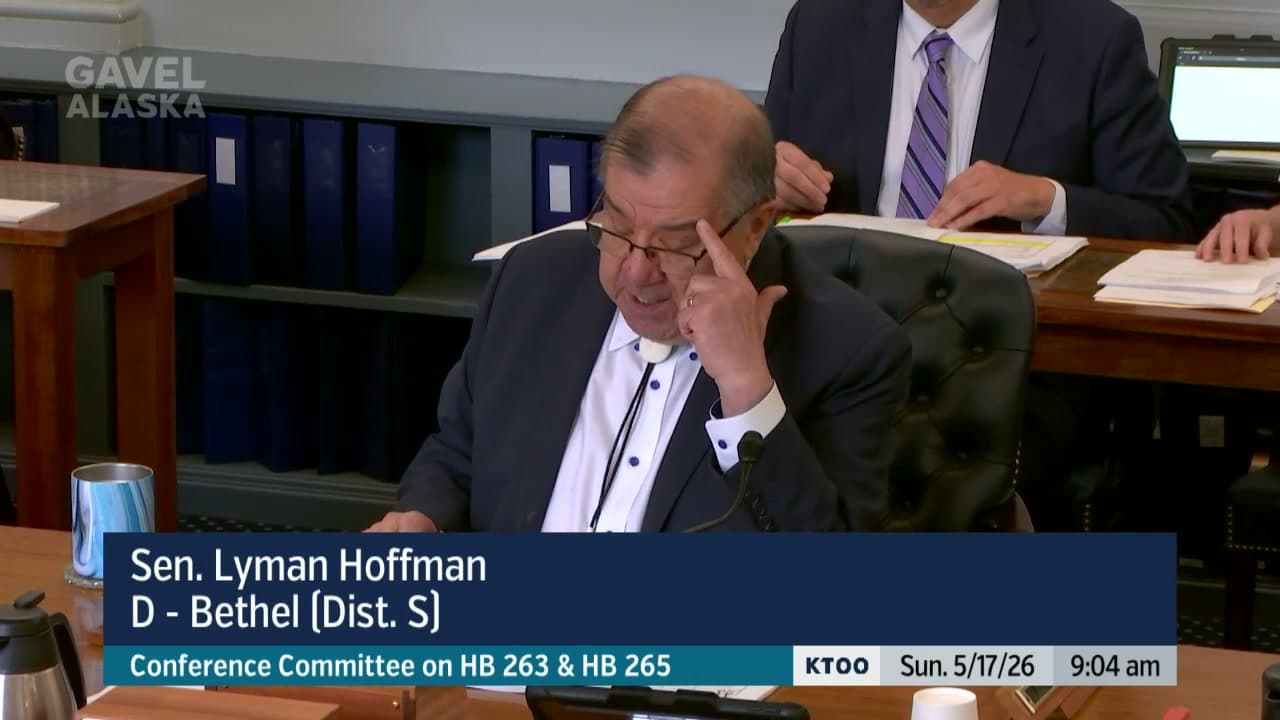
Frame from "MSC2-20260517-0900" · Photo source
Alaska Legislature approves $1,000 PFD, $200 energy relief payment
The Alaska Legislature conference committee approved a $1,000 Permanent Fund Dividend and raised energy relief payments from $150 to $200 per person in a split vote Sunday.
The conference committee voted 4-2 to set the dividend at $1,000. One senator objected that constituents needed a larger payment given high energy costs. The $1,000 figure had been the Senate position, passed 16-4 earlier as part of a wider debate over the dividend size versus budget reserves and future fiscal pressure. The committee then approved Amendment EA-2, which raised the energy relief payment by $50 per person at an estimated cost of $127.3 million. The amendment also increased the outside-the-BSA school payment from $111 million to $115 million.
Senator Lyman Hoffman, the conference committee chair, asked for a vote on the Senate position setting the dividend amount. Senator Mike Cronk objected to the motion.
"I'm just objecting because, you know, listening to constituents and what the high, actually, we had a really long winter, extremely high prices now that are looking like they're going to go into this winter," Cronk said. "I'm thinking the largest PFD that we could pay would be the best choice for Alaskans."
The committee voted 4-2 to approve the $1,000 dividend amount. Two House members and two Senate members voted yes. One House member and one Senate member voted no.
Representative Andy Josephson then moved to adopt Amendment EA-2, which increased the energy relief payment.
"Amendment EA-2 changes the amount of FY26 Energy Relief Permanent Fund dividend payment from $150 per person to $200 per person at an estimated total cost of $127.3 million," Josephson said. "This amendment also increases the outside-the-BSA payment from $111 million to $115 million. Finally, the amendment also appropriates $15 million to the Bulk Fuel Revolving Loan Fund at the end of the FY26 waterfall."
Representative Sapp questioned whether the $15 million appropriation to the Bulk Fuel Revolving Loan Fund would be sufficient if loan capacity reached its maximum. Legislative Finance Division staff said the amount was consistent with a roughly 50 percent increase in program usage. The exact need remained unclear.
Hoffman then asked about the waterfall structure. He confirmed that if surplus revenue proved insufficient after energy relief and K-12 formula funding, the bulk fuel fund capitalization would not occur. Staff confirmed that was correct.
The committee approved the amendment without objection after Sapp withdrew his objection.
The conference committee also approved Amendment 2 to the fiscal note package before adopting the amended packet. The committee then approved fiscal note packages for both the operating budget and mental health budget bills. Legislative Finance and Legislative Legal Services will make technical and conforming adjustments before reporting the bills out with individual recommendations.
The committee's actions closed all conferenceable items in House Bill 263 and House Bill 265. The conference committee concluded its work on the operating and mental health appropriation bills.
What did you make of this story? (no account needed)
Made by our human newsroom with AI. How humans and AI work here · Grow with our newsroom · Transcript byLucas Brown
Keep Alaska News free for everyone.
No paywall, ever. Members pay so everyone can read the meetings and records Alaska News covers.
Get Alaska News in your inbox
Create your free account and get the day’s top stories around 6 each morning, in a few minutes’ read.
Top stories, around 6 each morning.
Stories on what you follow, on Sundays.
This article is based on a public meeting of Alaska State Legislature — MSC2-20260517-0900 ().
Earlier in this story
Alaska Legislature Forms Conference Committee on $14B Operating Budget
Six Alaska lawmakers met Monday afternoon to hammer out differences between House and Senate versions of the state's fiscal year 2027 operating budget and mental health funding. The conference committee formed after the House rejected Senate changes to House Bill 265, leading House Speaker Bryce Edgmon to appoint three House members to negotiate with three senators.
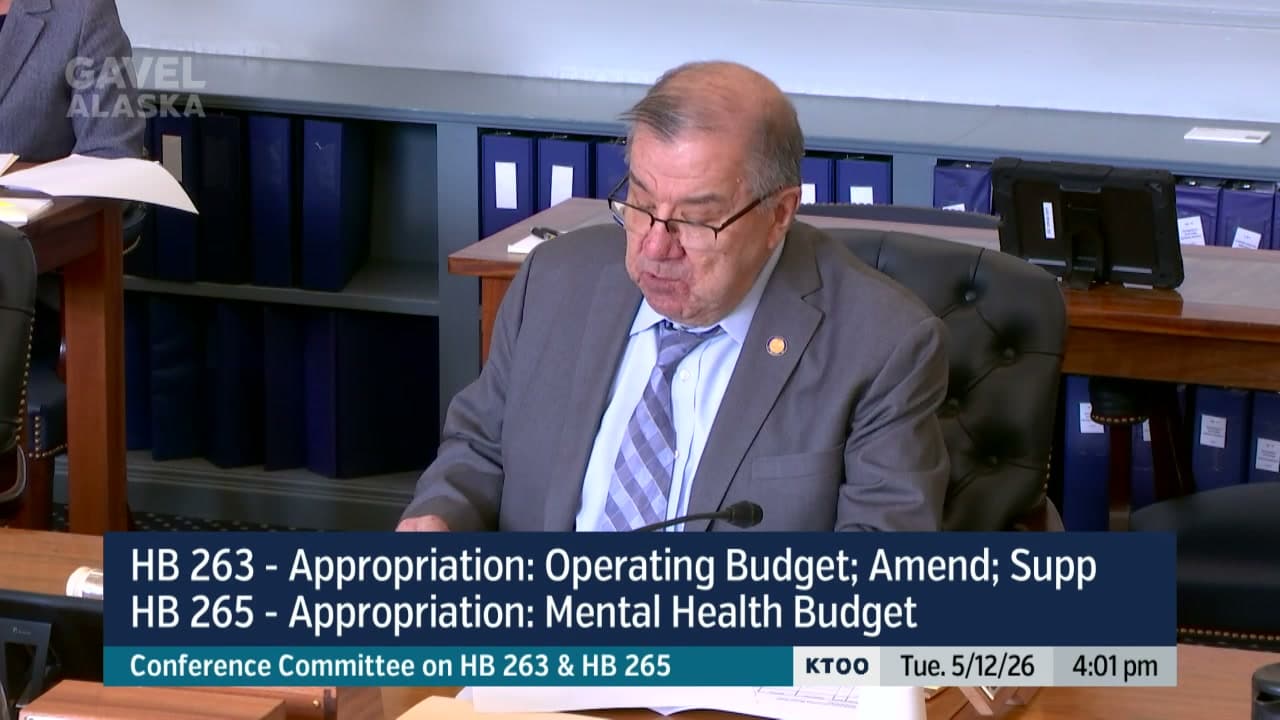
The committee will work through remaining gaps in House Bill 263, the roughly $14 billion operating budget, and House Bill 265, which covers mental health appropriations. The meeting started at 4:01 p.m. on May 11, 2026. Senator Lyman Hoffman chairs the committee, with Representative Andy Josephson as vice chair.
The conference committee stage comes after both chambers passed their own versions of the bills. Differences now need negotiation between the House and Senate. In summer 2021, the Legislature created a bipartisan Fiscal Policy Working Group to tackle long-term budget sustainability after years of falling oil revenues.
Committee Adopts Matching Items
The committee first approved all appropriations and language that matched in both versions. Hoffman then moved to request limited powers from the Speaker of the House and the Senate President to negotiate what remains.
"Under limited powers, the Conference Committee may adopt any amount between zero and the high number of either the House or the Senate version of each item subject to the conference," Hoffman said.
The committee approved letters to the Speaker and Senate President requesting those powers. Legislative Finance Division staff will prepare motion sheets showing the differences between the two versions. Those sheets will be posted on the Legislative Finance Division website and updated after each meeting.
Public Testimony Window Closed
Hoffman said the committee will not take additional public input. "Both House and Senate budget processes followed for public testimony," he said. "That portion of the process is now concluded. The conference committee will not be accepting public testimony."
Only conference committee members may join the discussion or sit at the table unless the chair invites others. The committee includes Senators Bert Steadman and Mike Cronk with Hoffman from the Senate, and Representatives Calvin Schragge and Will Stapp with Josephson from the House.
Next Steps
The committee will meet again once it receives the requested negotiating powers from legislative leadership. Future meetings will be posted on the Legislature's BASIS system to give 24-hour public notice under uniform rules. Each action needs a majority vote from both the House and Senate members of the committee.
The committee works under Uniform Rule 42, which sets conference committee procedures. A copy of Uniform Rule 42 and related legal opinions were included in each member's packet.
House rejects Senate's $1,000 PFD budget, sets up conference talks
The Alaska House of Representatives voted 36-0 Friday not to concur with the Senate's version of the state operating budget, moving the spending plan toward a conference committee to resolve a $477 million difference between the two chambers over the Permanent Fund Dividend and education funding.
The Senate also cut one-time education funding from $158.6 million to $29.1 million, a decrease of $129.5 million, with an additional contingent $111 million tied to the same revenue trigger.
Representative Andy Josephson explained the Senate amendments to the House. "Whereas the House appropriated a $1,500 permanent fund dividend, the Senate appropriates a $1,000 permanent fund dividend, a decrease of $318.4 million," he said.
Josephson, co-chair of the House Finance Committee, said the Senate version leaves $120 million in unrestricted general funds unspent before fiscal notes. "There are enough projected revenues for both House and Senate priorities," he said.
The Senate passed its operating budget Friday with a $1,150 dividend plus the $150 energy relief payment, according to Alaska News reporting. Senator Bert Stedman defended the Senate's approach to maintaining a fiscal cushion during that debate. "We are not too far apart, I don't think, from the House where we can get through conference and come to compromise. We have not changed our objectives of $73 a barrel, and we are holding, trying to hold everything within those bookends. Even though oil today is at $110 or some number north of that. We do not know what is coming this summer and into the fall. So this budget does not get enacted till July 1st," Stedman said.
Senator Bill Wielechowski explained the Senate's rationale for the lower dividend. "The reason Alaskans are not getting a larger PFD is really quite simple. For decades, oil funded 90% of our budget. It now funds 23%. We have no other source of revenue. That is as simple as it gets," he said.
The Senate removed several House priorities beyond education funding. It cut $17.5 million for the Alaska Heating Assistance Program, $15.4 million and $29 million in federal receipts to implement health-related recommendations, and $7.5 million for childcare workforce recruitment and retention. The Senate also removed $2.8 million to fully fund community regional jails, $4.5 million for recently unionized University of Alaska employees salary adjustments, $3.7 million and $4.3 million in federal receipts to maintain the Division of Public Assistance virtual contact center, $2.2 million for Alaska Gasline Development Corporation operating costs, $2.6 million to restore funding for highways and aviation support, $2 million for University of Alaska public safety and mental health support, $1.5 million to increase funding for adult day services, $1.8 million to meet Head Start grant match requirements, $1 million for food banks and pantries, $1 million for a geographic pay differential study, and $800,000 for emergency disaster grants and utility disruption.
The Senate increased some items the House had not funded as heavily. It added $50 million to Community Assistance, $20 million more than the House, plus $30 million to recapitalize the fund for a full distribution in fiscal year 2028. The Senate added $10 million to recapitalize the Disaster Relief Fund, bringing that fund to $48 million, and $5.7 million to the Fire Suppression Fund, raising it to $60.6 million.
House Majority Leader Dan Saddler moved to concur with the Senate changes but recommended members vote no, a procedural step to send the budget to conference committee. The House also rejected the Senate's mental health budget 10-26.
The Senate version of the mental health budget decreased operating expenditures by $4.6 million in general fund mental health appropriations. The Senate removed $4.3 million for behavioral health grants and $500,000 to maintain the crisis call center. The Senate added $5.2 million in AHFC dividends to increase funding for the AHFC Homeless Assistance Program capital item, bringing that item to $10.2 million in all funds.
"I ask you to vote no on concurrence so we can resolve these differences in conference committee, which I think we can do speedily," Josephson said.
Speaker Bryce Edgmon said he would appoint members to a conference committee to meet with Senate representatives to consider both the operating budget and the mental health budget if the Senate fails to recede from its amendments. The Legislature faces a May 20 deadline to pass a budget.
Alaska News previously reported that the House passed its operating budget with a $1,500 dividend on April 14 on party lines. The Senate Finance Committee reduced the dividend to $1,000 in early May to avoid a deficit, adding the potential $150 energy relief payment contingent on higher-than-forecast oil revenues.
Senate Passes Budget Balanced at $73 Oil, Rejects House's $320M Deficit Plan
Senate passed a $73-per-barrel budget with a $47.5 million surplus, rejecting the House plan that would need a $320 million draw from reserves.
Read this story
The Alaska Senate adopted a Finance Committee substitute for the state operating budget Wednesday that balances at $73 per barrel oil with a $47.5 million surplus, setting up negotiations with the House over a plan that would require a $320 million draw from the Constitutional Budget Reserve.
The Senate Finance Committee substitute for House Bill 263 advanced to third reading with differences in education funding, dividend amounts, and energy relief that will be resolved in conference committee in the final weeks of the legislative session. The Senate's $73-per-barrel framework matches the oil price assumption the Senate used in 2023 when it balanced the fiscal year 2024 operating budget at the same price with an $84.2 million surplus.
"The Senate operating budget, when combined with spending agreements for the capital budget, balances the budget on a $73 a barrel oil, with $47.5 million left over for next year's supplemental," Senator Bert Hoffman said. "The other bodies' budget, when combined with spending agreements for the capital budget, has close to a $320 million deficit at $75 a barrel oil."
The Senate budget provides a $1,000 Permanent Fund Dividend plus $150 in energy relief payments, totaling $1,150 per Alaskan. The House had approved a $1,500 dividend with no separate energy payment. The Senate approach funds energy relief and community assistance while offering a smaller dividend and rejecting House social service additions.
"In the permanent fund, we have added a permanent fund dividend of $1,000 at a cost of $674 million," Hoffman said. "The House had $1,500."
"In addition to $1,000 the Permanent Fund Dividend we have added $150 in energy relief payments using FY26 revenues of $96 million," Hoffman said. "We have included $29.1 million in FY27 to go out to grants to school districts to help defray high fuel costs. We have doubled the FY27 base payment of $20 million for community assistance to assist communities across the state of Alaska with high costs of energy."
Education funding differs significantly between the two versions. The Senate used $111 million in fiscal year 2026 funds for one-time grants outside the Base Student Allocation formula, plus $29.1 million in fiscal year 2027 for school district energy relief grants, for a total of $140.1 million. The House had used $147.6 million in fiscal year 2027 funds for BSA grants and $10.9 million for public transportation, totaling $158.5 million.
"We added $29.1 million to school district grants for the purposes of energy relief," Hoffman said. "The House added $147.6 million of outstanding outside the formula for the BSA and $10.9 million for public transportation, totaling $158.5 million."
The Senate also doubled community assistance funding to help municipalities cope with high energy costs. "We have added $20 million from the general fund to make additional community assistance base payments in fiscal year 2025 with the intent of helping communities with higher cost of fuel and shipping," Hoffman said.
The Senate rejected several House social service increments, including $7.5 million for child care workforce recruitment, $7.5 million for the Alaska Affordable Heating Program, $3.7 million and $4.3 million for the Public Assistance Field Service Virtual Contact Center, $1.5 million for adult day services, $403,000 for centers for independent living, $700,000 for senior centers, $382,000 for general relief temporary assistance living payments, and $15.4 million in various Medicaid-related items.
The Senate added $2.6 million to restore half of the highways and aviation maintenance funding cut in fiscal year 2026, and $30 million more than the House to the Community Assistance Fund, bringing the FY27 year-end balance to $90 million for fiscal year 2028 payouts.
The budget increased fire suppression funding from $54.8 million to $60.6 million to match the five-year average cost of fighting wildfires in Alaska, and increased disaster relief capitalization from $38 million to $48 million.
The Senate accepted $11.5 million in fiscal year 2026 supplemental requests that came in as amendments after March 13, including $4 million to defend the Val lawsuit on inmate care, $2.1 million for judgments and settlements, $1.25 million for village public safety officers, and $5.2 million for assistance at the Pioneer Homes.
The Senate bifurcated the governor's budget consistent with what the Legislature did last gubernatorial election. Approximately half of the governor's budget is effective July 1, 2026, through December 31, 2026, with the remainder effective January 1, 2027.
The bill will return to second reading on the next legislative calendar for consideration of any amendments before advancing to final passage.
Alaska Senate Passes Operating Budget With Energy Relief
Alaska Senate passed a $70 per barrel operating budget with $150 energy relief payments, avoiding a major Constitutional Budget Reserve draw that the House budget requires.
Read this story
The Alaska Senate passed its operating budget Friday that balances at $70 per barrel oil and includes $150 energy relief payments for Alaskans. The vote sets up conference committee negotiations with the House over spending priorities and use of state reserves.
The budget passed 17-3 after the Senate rejected four amendments and adopted four others and adopted four others.
Senate Finance Co-Chair Lyman Hoffman said the Senate budget balances at $70 per barrel oil with $46 million left over for supplementals next year when combined with capital budget spending agreements. The House budget, by comparison, runs close to $320 million in deficits at $75 per barrel oil.
The Senate version avoids tapping the Constitutional Budget Reserve, which held $3.5 billion at the start of fiscal year 2026. The House budget requires a CBR draw of more than $300 million.
The Senate budget includes a $1,000 permanent fund dividend base plus a $150 energy relief payment. Hoffman said the relief responds to fuel price spikes caused by war in Iran. School districts facing high fuel costs would receive $29.1 million in grants, calculated by taking each district's highest energy costs over the past three years and adding 30 percent.
The budget also doubles the base payment for community assistance to $20 million and fills the community assistance fund with $90 million to ensure a full $30 million payout in fiscal year 2028.
The Senate funded two major studies: $650,000 for an independent analysis of cost drivers in the Department of Corrections and $400,000 for a Base Student Allocation study.
Hoffman said the budget fully funds Alaska Retirement Management Board recommendations for PERS and TRS at $38 million, funds wildfire response at a five-year average of $60.6 million, and invests more than the five-year average for disaster relief at $48 million.
For the first time, the budget includes reverse sweep language to streamline year-end accounting. Hoffman said the provision would speed up the comprehensive financial report while sweeping less than $8 million into the CBR, reducing the days and weeks of accounting work to close out subfunds.
The Senate rejected four amendments from Republican members. An amendment by Senator Rauscher to direct $2 million in Arctic National Wildlife Refuge lease revenue to a state trooper post in Talkeetna failed 6-14. A second Rauscher amendment restricting community assistance funding from being used against resource development projects also failed 6-14, as did his amendment to fund a park ranger position in Valdez.
The most contentious vote came on an amendment by Senator Myers to pay a full statutory permanent fund dividend, which would have required drawing down the Constitutional Budget Reserve. The amendment failed 3-17 after extended debate.
The Senate adopted four amendments before final passage. Senator Stedman explained one amendment that backfills funding for crime victims as permanent fund dividends have declined.
The Senate also adopted amendments adding $28,300 for personal services and $563,700 in grants for domestic violence assistance, $650,000 for election security equipment and prepaid ballot envelopes, $1 million for special session expenses, and a technical correction reducing teachers' retirement system unfunded liability payments by $180,000 to match Alaska Retirement Management Board recommendations.
The budget now heads to a conference committee to resolve differences with the House version. Hoffman said the House used $147.6 million in fiscal year 2027 funds for a one-time BSA grant and $10.7 million for pupil transportation, totaling $158.5 million. The Senate used $111 million in fiscal year 2026 funds for a one-time BSA grant plus the $29.1 million in school fuel grants, totaling $140.1 million.
Senate President Gary Stevens announced the Constitutional Budget Reserve section also passed 17-3, meeting the three-quarters threshold required for CBR appropriations.
The Senate also passed the mental health budget 20-0, which adds $5.15 million to the Homeless Assistance Program to match Mental Health Trust recommendations and includes language to increase rates for private duty nurse services.
The conference committee will need to reconcile the two chambers' approaches to energy relief, education funding, and whether to tap the Constitutional Budget Reserve before the legislature adjourns in two weeks.









Comments
Sign in to leave a comment.
No comments yet. Be the first to share your thoughts.