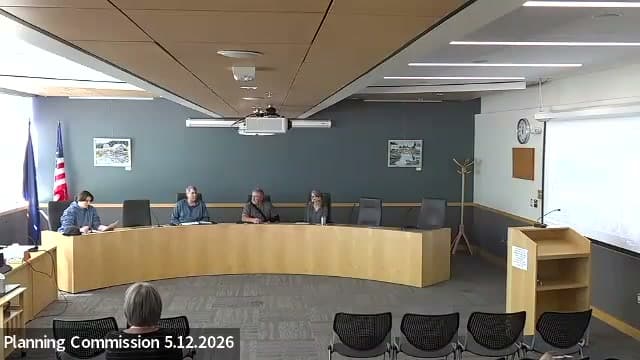
Frame from "Planning Commission Meeting 5.12.2026" · Source
Petersburg's Planning Commission on Tuesday advanced work on a cell tower overlay zone ordinance that would designate specific locations where wireless communication facilities may be built by right. The ordinance aims to give the community more control over tower placement while complying with federal law that prohibits outright bans.
The commission identified multiple potential tower sites during a work session. Sites include borough-owned land near the Baylor facility, Forest Service property above Scow Bay, and state land along Three Lakes Loop Road. The overlay would allow towers up to 200 feet tall with a setback of 110 percent of the tower height from property lines. Taller towers would require conditional use permits.
Commissioners said the overlay is needed because the Telecommunications Act does not permit municipalities to ban towers entirely. The community wants input on where towers are located.
"It's because of the community desire to choose and recommend certain sites to wireless communication companies, so as to limit surprise and have some sort of public input in the locations," Planning Commissioner Glorianne Wollen said.
The overlay would make it easier for wireless companies to identify suitable sites, commissioners said. Companies could review the map and select locations the borough has designated for towers, choosing sites that meet their technical needs while providing setbacks from residential areas.
The commission discussed including a strip along the back of industrial lots above Scow Bay, the south half of the lot where the Baylor facility sits, and a portion of borough-owned land behind the water treatment plant. Commissioners also identified Forest Service land near Raven's Roost and state land near the Three Lakes Loop Road mill as potential sites.
Some sites near the airport may be constrained by Federal Aviation Administration setback requirements. Commissioners said those requirements would need to be verified before finalizing the overlay boundaries.
The overlay would allow towers by right if they meet setback and height standards. Towers exceeding 200 feet or other standards would require a conditional use permit. The setback requirement would be 110 percent of the tower height from property lines.
The commission discussed including private properties in the overlay only if owners express interest. The public notice process will allow property owners to state whether they support or oppose inclusion in the overlay designation.
"The good thing about the notice process is that anything we're including in the overlay, we have to notice private persons. And so they would get a chance to say, like, no, I don't want this in the overlay, or I very much do want this in the overlay," one commissioner said.
This article was drafted with AI assistance and reviewed by editors before publishing. Every claim can be verified against the original transcript. If you spot an error, let us know.
Watch key moments from the source meeting. Click to expand.
Related Coverage
Planning Commission approves temporary RV for construction site
Alaska News · 15h ago · 75% match
Commission Approves Explosives Storage Site for Avalanche Control
Alaska News · 3w ago · 9 views · 75% match
Commission approves subdivision, rezone for Native Village of Ouzinkie tsunami shelter
Alaska News · 15h ago · 74% match
Kodiak Borough Lands Committee develops framework to streamline land disposal
Alaska News · 3w ago · 4 views · 74% match
Kenai Planning Commission recommends rural residential rezone, rejecting city's denser proposal
Alaska News · 9h ago · 74% match
Comments
Sign in to leave a comment.
No comments yet. Be the first to share your thoughts.