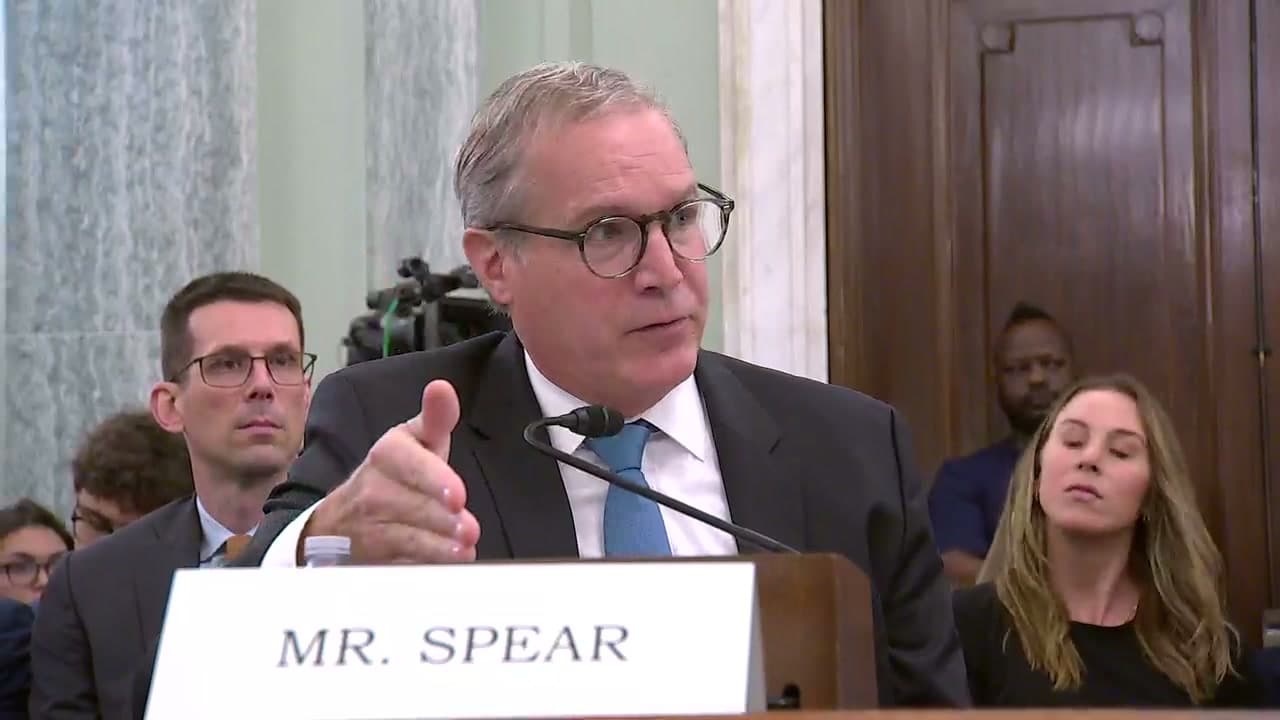
Frame from "Senate Senate Commerce, Science, and Transportation Subcommittee on Surface Transportation, Freight, Pipelines, and Safety (Sullivan): Hearings to examine how technological advances are driving transportation innovation." · Source
Trucking groups, labor split on autonomous vehicle regulation
Trucking and technology groups urged a Senate subcommittee Tuesday to establish a unified federal framework for autonomous vehicles to prevent a patchwork of state rules and speed commercialization. Labor representatives called for binding premarket safety standards and federal oversight that go beyond industry self-certification.
Chris Spear, president of the American Trucking Associations, told the Senate Commerce, Science and Transportation Committee's Surface Transportation Subcommittee that Congress should solidify the National Highway Traffic Safety Administration's role as the primary authority over motor vehicle safety standards and create a clear national strategy for autonomous commercial vehicles. Spear tied his comments to the Build America 250 Act and urged Congress to repeal the 12% federal excise tax on heavy-duty trucks.
Congress should establish and implement a federal framework for autonomous commercial vehicles. These systems hold real promise to enhance safety, improve productivity, and strengthen America's economic competitiveness, but only if deployment is governed by a clear national strategy.
Cole Scandaglia, deputy director of political action for the International Brotherhood of Teamsters, countered that the federal government has failed to advance meaningful autonomous vehicle regulation beyond requiring crash reports to NHTSA. He said Congress must require robust premarket standards at NHTSA to determine what must be on a vehicle to make it safe before it hits the road. He also called for substantial oversight tools at the Federal Motor Carrier Safety Administration to monitor how autonomous vehicles function once deployed.
We continue to call Congress to create a binding framework that prioritizes safety, the workforce, and goes beyond weak self-certification regimes.
Committee Chair Sen. Ted Cruz has argued that the absence of a clear federal framework for autonomous vehicle deployment is unsafe and that Congress must establish consistent national rules to avoid a patchwork of state AV laws. Prior federal legislative efforts such as the SELF DRIVE Act and AV START Act proposed to clarify NHTSA's federal role over highly automated vehicle design and performance, to preempt certain state vehicle design regulations, and to require safety assessment submissions from developers. Those bills stalled.
Laura Chase, president of the Intelligent Transportation Society of America, told the subcommittee that federal leadership plays a critical role and that establishing consistent national frameworks for areas such as automated vehicles, data privacy, and system interoperability can help ensure that innovation is deployed safely and at scale. She warned that without federal leadership, the country will continue to see fragmented, uneven deployments that struggle to deliver system-wide benefits. The private sector is asking for a unified national marketplace, she said.
AI-assisted, reviewed by editors. Spot an error?
Watch key moments from the source meeting. Click to expand.
Related Coverage
Alaska considers ban on driverless commercial trucks amid safety debate
Alaska News · 2mo ago · 19 views · 81% match
Alaska Senate panel advances autonomous vehicle restrictions despite industry opposition
Alaska News · 3w ago · 5 views · 79% match
Alaska bill would require human operators in autonomous freight trucks
Alaska News · 1mo ago · 4 views · 79% match
Senate panel hears autonomous vehicle bill requiring human operators
Alaska News · 1mo ago · 3 views · 77% match
Senate panel advances bill requiring humans in autonomous commercial vehicles
Alaska News · 3w ago · 6 views · 77% match
Comments
Sign in to leave a comment.
No comments yet. Be the first to share your thoughts.